

The customer price is not always the professional payout
A customer may pay one amount for an event staffing service while the professional who completes the shift receives another. The difference is not automatically unfair: a complete service can include taxes, payment processing, verification, customer support, coordination, replacement handling and other disclosed operating costs.
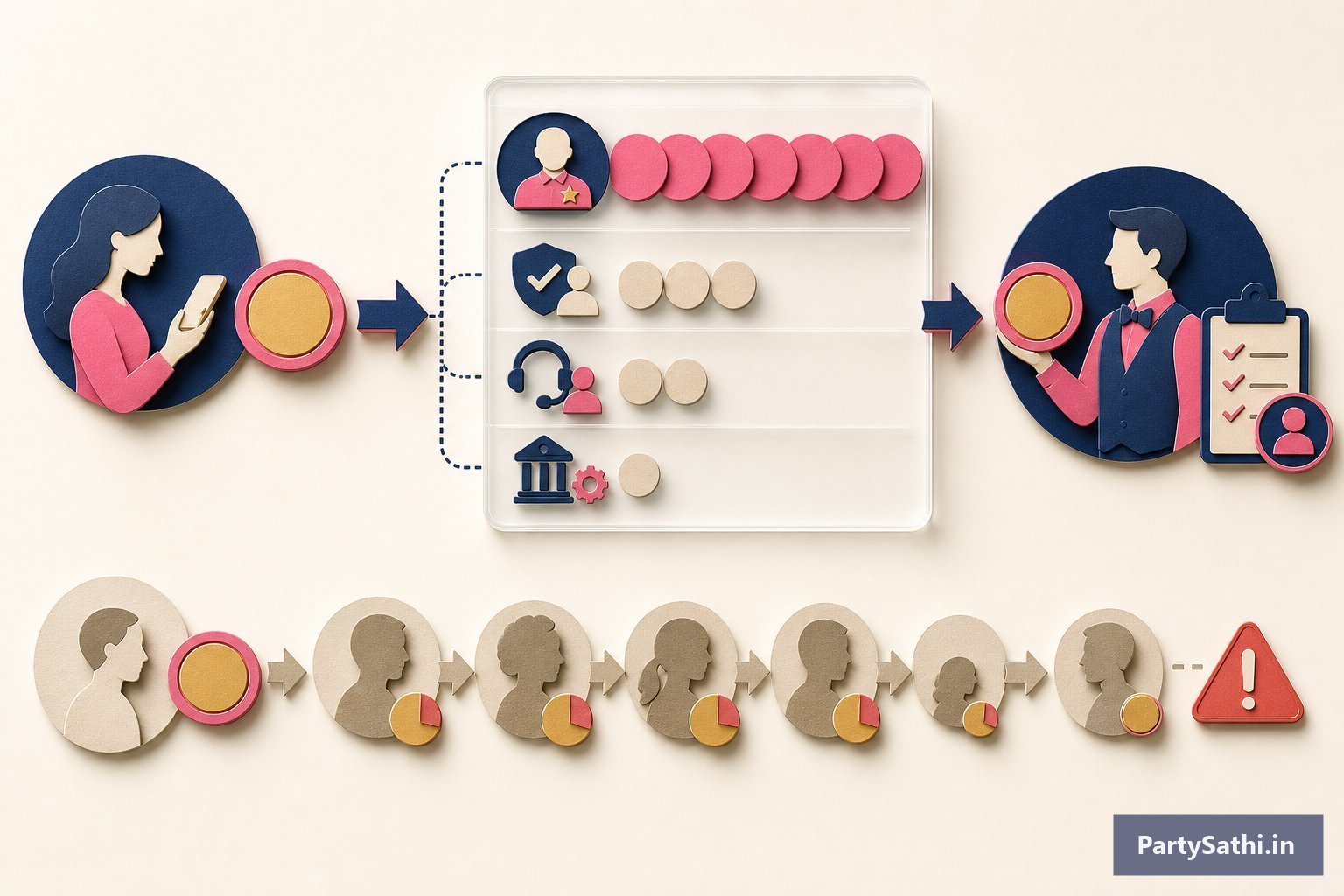
The concern begins when several intermediaries pass the same requirement down a chain and each retains an undisclosed share. The customer may believe the full amount reflects the person delivering the work, while that professional may never see the original booking value or know how it was divided.
How repeated subcontracting can reduce earnings
Imagine that a customer asks one coordinator for two event professionals. That coordinator passes the requirement to another supplier at a lower amount, who passes it to a smaller local contact at a lower amount again. The final contact recruits the people who actually report for the shift.
Every layer may keep part of the difference even when it adds little operational value. By the time the requirement reaches the professionals, their offered earnings can be much lower than the amount the customer associates with each person.
A hypothetical ₹1,000 example
For simple arithmetic only, suppose a customer price is ₹1,000 per professional. One intermediary offers the requirement onward at ₹900, the next at ₹750 and another at ₹600. The professional may finally be offered around ₹500 or ₹600 even though the customer paid ₹1,000.
These figures are illustrative, not PartySathi pricing, an industry average or a claim about a particular agency. Real amounts vary, and a legitimate provider may retain a clearly disclosed fee for services it actually performs. The problem is the invisible chain, not every difference between price and payout.
Why the customer can also lose value
A long chain weakens communication. Venue access, dress, timing, tasks and changes may be reworded or omitted each time the requirement is forwarded. The customer may not know who is actually assigned until shortly before the event.
If someone cancels or the schedule changes, responsibility can become unclear. Each contact may call the next layer instead of resolving the issue from one accurate booking record.
Why professionals can be disadvantaged
The professional may receive incomplete instructions, uncertain earnings or no clear record of who approved an extended shift. They may also have little visibility into attendance confirmation, deductions or payout status.
Lower earnings can be especially difficult when travel, reporting time and shift preparation were not explained in advance. A professional should be able to review the role, venue context, timing and offered payout before accepting.
What legitimate service costs can cover
A staffing marketplace or provider still has real responsibilities. Identity and KYC review, technology, support, secure payment handling, attendance records, refunds, dispute review and payout operations all require systems and people.
The fair test is transparency and value. Charges, commissions, statutory deductions or wallet adjustments should be disclosed where applicable, and both sides should understand which services the platform is providing.
How PartySathi is designed to reduce opaque layers
PartySathi is designed as a technology-enabled marketplace connecting customers with nearby independent event professionals through a recorded booking and assignment flow. Customers request the required service through PartySathi instead of relying on a chain of unrelated brokers to forward the same requirement.
PartyStaff lets eligible professionals review nearby opportunities with role, timing, venue context and staff payout information before accepting. Booking, attendance, completion, earnings and payout records remain connected to the assignment rather than being reconstructed through several personal calls.
Direct does not mean unsupported or cost-free
Removing unnecessary intermediaries does not mean removing verification, support, technology or payment operations. PartySathi may record applicable platform fees, commissions, statutory deductions or other adjustments where disclosed and legally permitted.
The objective is a shorter, visible operating path: the customer knows which platform is responsible for the booking, and the professional can review the offered payout and assignment details. Fewer hidden handoffs can leave more room for fair professional earnings while preserving the services needed to make the booking work.
What customers should check before booking
Ask whether the provider is fulfilling the requirement directly through its registered professional network or repeatedly subcontracting it. Review the complete service total, included support, change terms and who is responsible for the assigned team.
Keep payment, role quantities, timings and changes in the official booking channel. Avoid sending funds to an unknown person merely because a requirement has been forwarded through a familiar contact.
What event professionals should check
Review the offered payout, role, full shift, location, dress and task expectations before accepting. Check how attendance is recorded, when payout becomes eligible and which disclosed deductions may apply.
Use your own verified profile and payout method. If the amount or assignment details change, request confirmation in the platform record before performing additional work.
Transparency is the practical standard
Customers deserve to know what service they are buying, and professionals deserve to know what work they are accepting and what they can earn. A transparent platform does not need to pretend that operations have no cost; it needs to show the relevant amounts and responsibilities clearly.
By connecting nearby customers and professionals in one booking system, PartySathi aims to replace the opaque forwarding chain with documented discovery, assignment, attendance, support and payout workflows.