
Guest count is only the starting point
It is tempting to choose a team using guest count alone, but two events with 100 guests can require very different staffing. A relaxed buffet in one compact room is simpler to operate than a plated dinner across several service areas, even when the invitation list is identical.
Begin with the number of expected guests, then review how they will arrive, eat, drink and move through the venue. The right team is the one that can complete those tasks safely and consistently—not the one produced by a single universal ratio.
Use service-style ratios as planning ranges
For an uncomplicated buffet, one waiter for roughly 25 to 35 guests can be a useful early planning range. A seated or plated meal may need closer to one waiter for every 10 to 15 guests because table service, clearing and course timing create more individual work.
These figures are starting points, not guarantees or fixed PartySathi staffing standards. Menu complexity, venue rules, service expectations and the experience of the team can move the requirement in either direction. Share the complete plan before confirming quantities.
Count each active service point
A buffet needs people to replenish or coordinate food, clear used plates and support guests away from the counter. If food is served from two floors or separate indoor and outdoor areas, each area may need dedicated coverage even when the total guest count is modest.
The same principle applies to live counters, dessert stations, water service and VIP seating. Map the places where work happens at the same time. A team that looks sufficient on paper can become stretched when everyone is required in different zones.
Estimate beverage service separately
Do not assume the food-service team can automatically operate the beverage counter as well. A simple soft-drink station requires different support from a made-to-order beverage menu with glassware, garnishes and frequent restocking.
For a straightforward bar setup, one bartender for around 40 to 60 guests may be an initial discussion point, supported by a helper when restocking, glass collection or more complex preparation is expected. Alcohol service must follow venue rules, applicable law and appropriate age and safety controls.
Add hosts where arrivals need coordination
A host or hostess can be valuable when guests need to be welcomed, checked against a list, directed to different areas or guided through a schedule. One clear entrance may need only one person, while multiple gates, registration desks or guest categories can require separate coverage.
Keep this role focused. If the same person must manage registration, answer venue questions, coordinate vendors and make announcements, the arrival experience may slow down at the busiest moment.
Include setup, clearing and operational support
Guest-facing service is only part of the shift. Tables may need to be checked before arrival, counters prepared, supplies moved, waste handled and the venue reset after service. Discuss who is responsible for these tasks instead of assuming they are included.
An event helper or housekeeping professional may be more useful than adding another waiter when the main pressure comes from movement, replenishment or continuous cleaning. Match every added person to a defined workload.
Increase coverage for difficult venue layouts
Stairs, long distances between the kitchen and dining area, service lifts, security checks and separate indoor or outdoor spaces all consume time. When staff spend more of the shift walking or waiting for access, they have less time for direct service.
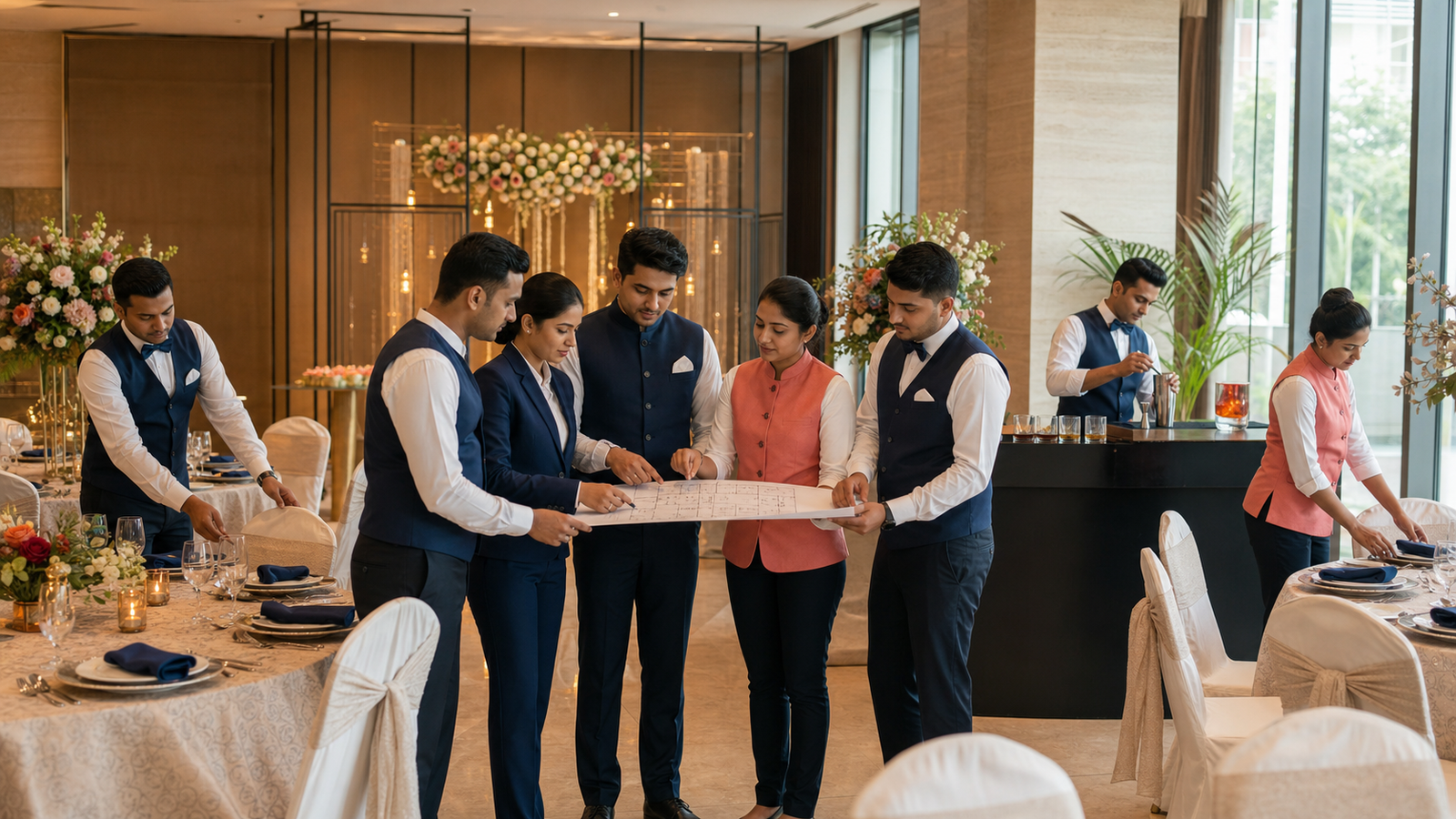
Share a floor plan or explain the route from preparation areas to guests. For larger venues, assign zones and nominate a lead so professionals know where they are responsible and who can rebalance the team if one area becomes busy.
Plan around the busiest period
Average workload can hide a short, intense peak. Guest arrival, the opening of a buffet, a toast or the end of dinner may place most demands within a 20-minute window. Build the staffing plan around those moments rather than the quietest part of the schedule.
Write a simple timeline showing reporting, setup, guest arrival, food service, key activities and closing. If several important tasks overlap, either add coverage or simplify the service plan so the existing team can deliver it properly.
Turn your estimate into a clear requirement
Before booking, record the date, complete address, expected guest count, service format, number of counters and rooms, shift timing, dress requirement and tasks for each role. Mention venue access, alcohol service, equipment and cleanup expectations.
Ask the provider or operations team to review the proposed quantities against this information. Keep the final roles, numbers, timings and price connected to the booking, and update them promptly if the guest count or service format changes.
Choose reliable service over a perfect-looking ratio
A staffing ratio is useful only when it reflects the actual work. Too few people can lead to slow service, unclear priorities and unsafe pressure; too many without assigned responsibilities can create confusion and unnecessary cost.
Use ranges to begin the conversation, then make the final decision from the venue, schedule and service details. A clear brief, defined zones and one available on-site contact will usually improve the event more than relying on a number alone.