
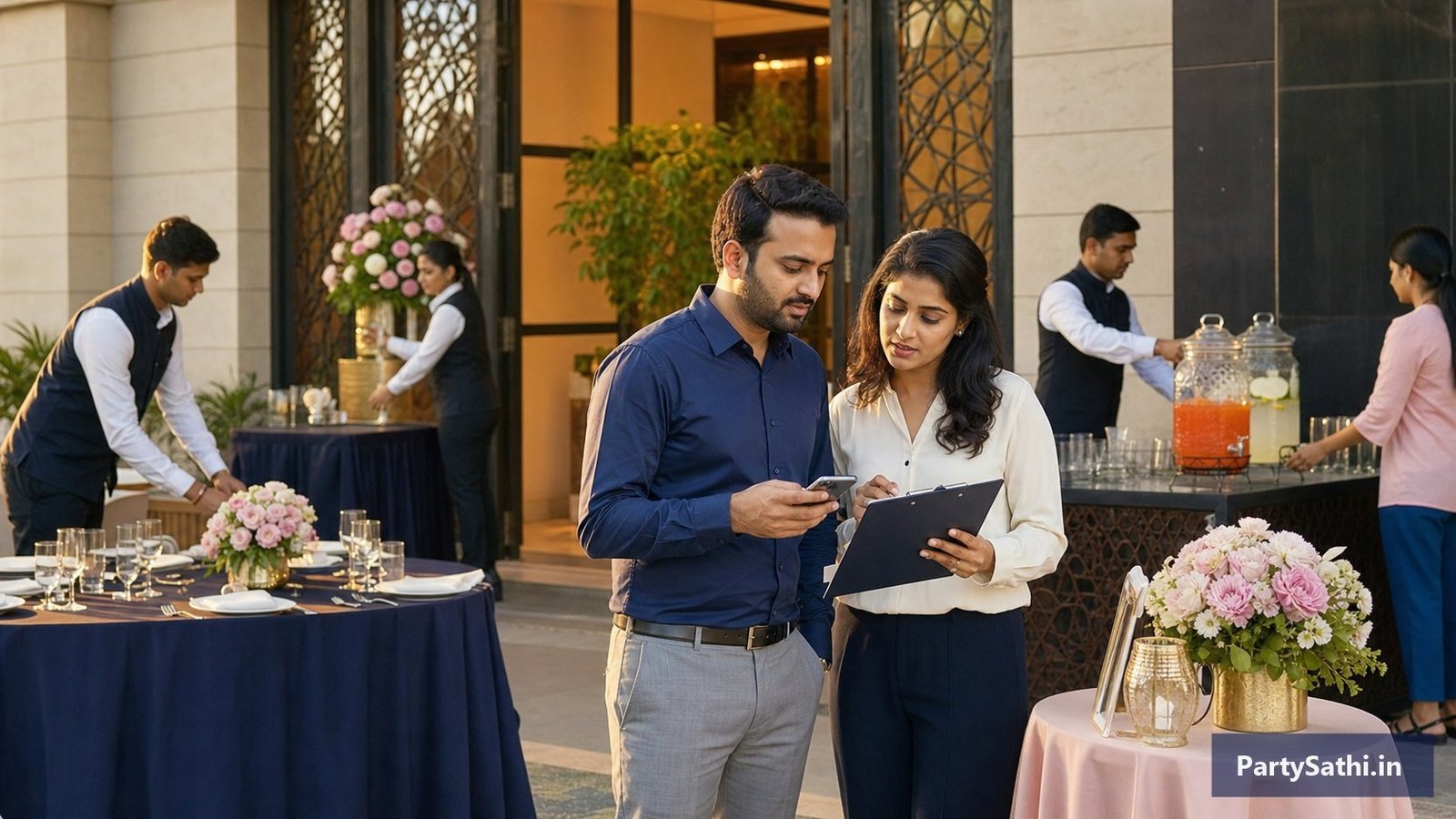
First, decide whether the request is still practical
A same-day request has less time for matching, travel and briefing, so begin with the actual event schedule. Record when professionals must report, when guests arrive and the latest time at which additional support would still be useful.
Availability depends on the role, location, shift length and current supply. Treat an urgent request as subject to confirmation and prepare a simpler fallback plan in case the full quantity cannot be arranged.
Confirm the exact venue and reporting point
Share the complete address, nearby landmark, entrance, floor and reporting contact. Large hotels, farmhouses, residential societies and convention venues may have multiple gates or restricted service access.
Mention parking limitations, security checks, loading entrances and the expected travel conditions. A professional who reaches the property but cannot locate the reporting point is not yet available to support the event.
List roles and quantities by priority
Separate essential roles from useful additions. For example, food service, beverage control and guest arrival may be essential, while some setup or decorative tasks could be simplified if availability is limited.
Request realistic quantities and identify the minimum workable team. Do not combine unrelated specialist responsibilities under a vague label such as event staff.

Provide the guest count and service format
Share the expected guest count and whether the event uses buffet, plated, counter or passed service. Mention the number of rooms, floors, bars, buffet points or registration desks that need coverage.
These details help reviewers assess the workload instead of relying only on headcount. Fifty guests across several service areas may require a different plan from a larger group gathered in one compact space.
State the complete shift and dress requirement
Include reporting time, briefing time, guest-facing hours and the expected finish. If closing or cleanup support is required, include it rather than ending the shift when guests are scheduled to leave.
Keep dress instructions simple and achievable at short notice. State the required colour and garment clearly, and disclose whether any specific uniform item will be provided at the venue.
Prepare one concise task brief
Write the essential tasks for each role, the supervisor and the service priorities. Include relevant venue rules, food or beverage boundaries, equipment restrictions and anything the professional should not handle.
Avoid sending several long voice messages with changing instructions. A short written brief gives the assigned professional and support team one reliable version to follow.
Keep an authorised contact available
Nominate one person who can answer calls, confirm changes and meet professionals at the reporting point. Share an alternate contact only if the primary person may become unavailable during setup.
Urgent coordination slows down when several family members or vendors provide conflicting directions. One authorised contact keeps decisions and operational updates clear.
Review confirmation before relying on the request
Check the confirmed role, quantity, reporting time, price and communication channel. A submitted request or ongoing conversation is not the same as a confirmed assignment.
If only part of the requirement can be fulfilled, decide which service areas to protect and communicate the revised plan to the venue and remaining team. Keep every agreed change recorded.
Use the checklist to reduce the next rush
After the event, save the final role list, timings, address instructions and brief as a reusable starting point. Note which quantities worked and where the team was stretched.
For important or larger events, submit the requirement earlier whenever possible. Same-day support can be valuable when available, but lead time creates more room for suitable matching and organised coordination.