
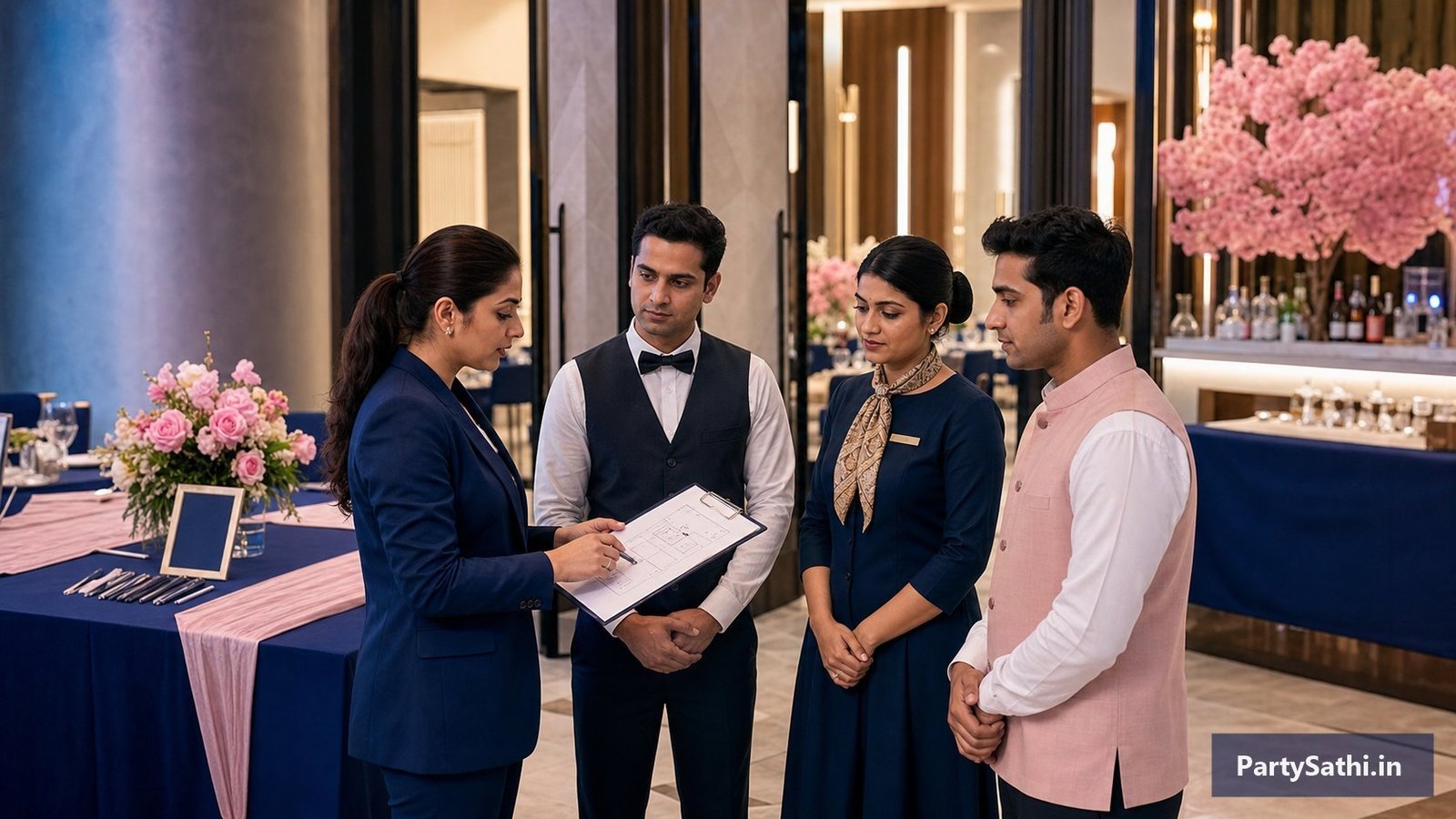
Why a written brief matters
A clear brief gives the host, coordinator and assigned professionals one shared understanding of the event. It reduces repeated questions and helps the team distinguish essential responsibilities from optional requests.
The brief should support a short event-day conversation, not replace all human coordination. Keep it concise enough to review quickly while including the details that would otherwise cause delays or conflicting instructions.
Begin with the event basics
State the event type, date, complete venue address, reporting point, shift timing and expected guest count. Include the name and phone number of the person authorised to receive the team and approve operational changes.
Mention whether the event uses one room or several service areas, and identify any security desk, service entrance, parking restriction or access check that may affect arrival.
Define every role through its tasks
List what each role needs to accomplish rather than relying only on titles such as waiter, host or event helper. Explain the assigned zone, service format, priorities and supervisor.
Separate tasks that require specific experience from flexible support. This helps prevent a professional from being redirected into equipment handling, security, cash, food preparation or another responsibility they were not assigned or prepared to perform.

Describe the guest journey and service priorities
Explain how guests will arrive, where they should be directed and how food, beverages or registration will work. Identify the moments that need the most attention, such as guest arrival, dinner service or closing.
If the schedule slips, the team should know which outcomes remain essential. Priorities allow the supervisor to make sensible adjustments instead of treating every task as equally urgent.
Include reporting, breaks and finish expectations
Distinguish reporting time from guest arrival time. Allow enough time for attendance, venue orientation, role allocation and a concise briefing before service begins.
Record the expected shift finish, break arrangement and whether cleanup or closing support is included. Do not leave post-event work implied when the listed shift ends with the public programme.
Make the dress requirement achievable
Use precise but simple instructions such as garment type and colour. If the venue or host will provide an apron, badge, jacket or other item, say where and when it will be issued.
Avoid changing the dress requirement immediately before reporting unless the replacement item is supplied. A consistent professional appearance is easier to achieve when expectations are communicated early.
State boundaries and venue rules
Identify restricted areas, equipment rules, alcohol-service boundaries, cash-handling limits and privacy expectations. Mention whom the team should contact if a guest requests something outside the assigned service.
Clear boundaries protect the host, venue and professionals. They also reduce the risk of well-intentioned staff accepting instructions from several people who do not have authority over the shift.
Create one escalation path
Name the on-site supervisor and the person who can approve material changes. Explain how the team should report access problems, safety concerns, guest incidents or a change that affects timing or workload.
For larger events, the operational contact and commercial approver may be different people. Make those responsibilities explicit so an urgent service decision does not wait for the wrong contact.
Control versions and confirm changes
Keep the brief in one recorded channel or central document. When something changes, update the main version and identify the revised detail rather than sending a new chain of disconnected messages.
Before the event, recheck the final date, address, roles, quantities, timings and contacts. On arrival, use the written brief to deliver a short verbal orientation and invite essential questions.
Keep the brief specific, respectful and realistic
Useful instructions describe outcomes and responsibilities without micromanaging every movement. Write in direct, respectful language and avoid assumptions that one role should absorb unlimited unrelated work.
A strong brief does not need to be long. It needs to be current, operationally clear and shared with the people responsible for delivering and supervising the event.